Agent assist chatbots are transforming customer support by acting as AI co‑pilots for human agents. By providing information on defining the next era of business growth, these tools help teams deliver faster, more accurate, and more personalized support. They are no longer just limited to call centers—they are part of a larger ecosystem where AI technologies are enhancing business operations across multiple areas.
Modern organizations are using artificial intelligence technologies for customer support automation and real-time conversation analytics, machine learning platforms for predictive business insights, and AI-powered business process automation tools to streamline workflows. In marketing, AI-driven marketing automation platforms for personalized campaigns, digital marketing with intelligent content optimization, and predictive customer engagement tools are helping businesses reach the right audience at the right time. In finance, AI-powered financial forecasting and risk management software and intelligent accounting automation systems allow teams to make faster, data-driven decisions while reducing errors.
All these modern technologies integrate seamlessly with future of remote workforces AI call center solutions, where agent assist chatbots not only support live customer interactions but also provide insights from multiple AI systems across marketing, finance, and operational technologies. By connecting these tools, organizations can enhance agent efficiency, improve customer satisfaction, and enable human teams to focus on complex, high-value work instead of repetitive tasks.
This guide explains what an agent assist chatbot is, how it works, and how it can upgrade your customer experience and your team’s performance, while showing how AI technologies across business functions—marketing, finance, digital operations, and more—work together to drive smarter, faster, and more efficient business outcomes.
Top Contact Center Solutions for AI-Powered Agent Assist Chatbots
Choosing the right contact center solution can make a huge difference in improving customer experience, agent efficiency, and overall business performance. Here’s a list of top platforms that excel in integrating AI technologies, including agent assist chatbots, to enhance support operations.
1. Bright Pattern – AI Contact Center Solution
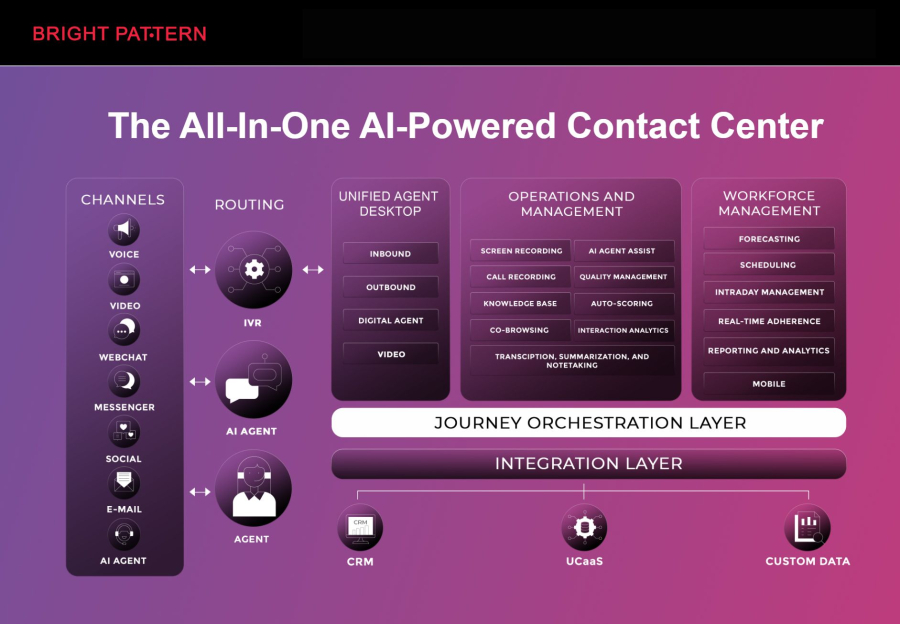
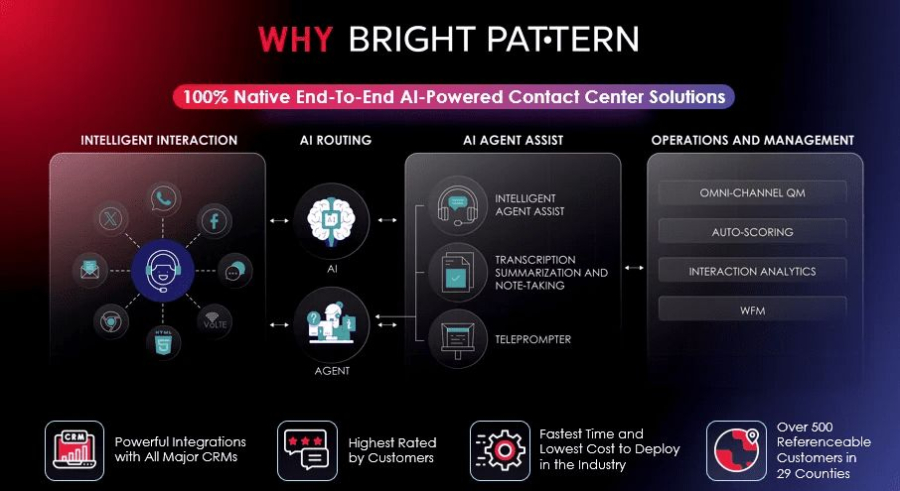
Bright Pattern is a leading cloud-based contact center platform designed for modern customer support. With its advanced AI capabilities, including agent assist chatbots, Bright Pattern helps businesses deliver fast, accurate, and personalized service across multiple channels.
Key Features:
- AI-powered agent assist to provide real-time suggestions during live calls and chats
- Omnichannel support including voice, chat, email, SMS, and social media
- Predictive analytics to identify trends and improve customer satisfaction
- Integration with CRM, marketing, and business intelligence platforms
- Scalable cloud infrastructure for future-proof contact center operations
Bright Pattern enables teams to streamline workflows, reduce agent burnout, and provide a more seamless customer experience through AI-driven tools.
2. Five9 – Intelligent Cloud Contact Center
Five9 offers a cloud-based contact center platform with AI-driven automation, predictive dialing, and virtual agents. It helps organizations improve agent productivity and reduce call handling times.
3. Genesys – Omnichannel Customer Experience
Genesys provides a complete AI-powered contact center solution that integrates voice, chat, and social media channels. Their AI tools include predictive routing and agent assist chatbots to support live conversations.
4. RingCentral Contact Center
RingCentral combines cloud telephony with AI capabilities, offering smart routing, real-time analytics, and agent assistance to optimize customer support and increase efficiency.
5. Talkdesk – Cloud Contact Center Platform
Talkdesk uses AI to enhance agent performance with real-time suggestions, automated workflows, and sentiment analysis, making customer interactions faster and more accurate.
6. NICE inContact CXone
NICE inContact CXone provides an AI-driven platform for managing omnichannel customer interactions. Its agent assist chatbot features help support agents deliver accurate information during calls and chats.
7. 8x8 Contact Center
8x8 delivers a cloud contact center solution with integrated AI for real-time agent assistance, customer engagement insights, and workflow automation across multiple communication channels.
8. Vonage Contact Center
Vonage uses AI to power virtual agents, agent assist tools, and analytics dashboards, helping companies streamline operations and provide consistent customer support.
9. Aspect Software – Aspect Unified IP
Aspect’s cloud contact center solution integrates AI tools like predictive routing, agent assistance, and analytics to optimize agent workflows and enhance the customer experience.
10. Salesforce Service Cloud – AI-Enhanced Support
Salesforce Service Cloud leverages AI to support agents with real-time guidance, knowledge suggestions, and automated workflows, improving efficiency and customer satisfaction.
What Is an Agent Assist Chatbot?
An agent assist chatbot is an AI tool that supports human agents during customer interactions across channels such as chat, email, messaging, and phone. Instead of talking directly to customers like a traditional chatbot, it operatesbehind the scenesin the agent's workspace.
It can:
- Suggest replies based on the ongoing conversation
- Surface relevant knowledge base articles and policies
- Summarize long tickets or past interactions
- Auto‑fill fields and draft case notes
- Highlight next best actions and escalation paths
Think of it as a digital teammate that never gets tired, forgets a policy, or loses context, helping every agent perform more like your seasoned experts.
Key Benefits of Agent Assist Chatbots
When implemented well, agent assist chatbots deliver benefits across your entire support operation.
1. Faster Response and Resolution Times
Agents no longer have to search across multiple tools and documents while juggling a live conversation. The assistant proactively surfaces relevant content and suggested replies as the conversation unfolds.
That typically leads to:
- Shorter average handle timebecause agents spend less time looking for answers
- Quicker first responsesin chat and messaging channels
- Fewer transfers and escalationsbecause front‑line agents feel confident resolving more issues
2. Higher Consistency and Accuracy
Support quality can vary widely between new hires and senior agents. An agent assist chatbot narrows that gap by delivering consistent, up‑to‑date guidance to everyone.
- Policy‑aligned responsesare suggested automatically, reducing the risk of giving incorrect information.
- Up‑to‑date knowledgeis surfaced from a centralized knowledge base, which is easier to maintain than scattered documents.
- Compliance‑friendly workflowsguide agents through regulated steps for things like refunds, verifications, or data changes.
3. Improved Agent Experience and Reduced Burnout
High support volumes and complex customer expectations can quickly overwhelm teams. Agent assist tools remove much of the manual, repetitive work so agents can focus on what humans do best: empathy, judgment, and relationship‑building.
- Less "tab hopping" and copy‑pasting between systems
- Fewer repetitive questions, thanks to quick suggestions and templates
- More confidence for new agents, who get in‑flow guidance instead of constantly asking for help
The net effect is a smoother, more rewarding workday and lower turnover over time.
4. Stronger Customer Satisfaction (CSAT) and Loyalty
Customers notice when your agents are informed, responsive, and consistent. Agent assist chatbots help deliver that experience repeatedly, even during peak times.
- Customers getfast, accurate answerswithout feeling rushed.
- Personalization improves because the assistant can highlightthe right contextfrom past interactions.
- Agents have more mental bandwidth for empathy, which builds trust and loyalty.
5. Better Operational Insights
Because agent assist chatbots sit on top of your conversations, they can generate rich operational data:
- Common pain points and recurring issues
- Content gaps in your knowledge base
- Training needs by team, queue, or topic
These insights help you fine‑tune both your AI assistant and your broader support strategy.
How Agent Assist Chatbots Work
While implementations vary, most agent assist systems follow a similar pattern from the moment a conversation begins.
1. Capture and Understand the Conversation
The agent assist chatbot first needs to understand what is happening in real time.
- For chat and messaging, it reads the text directly.
- For voice calls, it uses speech‑to‑text to create a live transcript.
Natural language processing (NLP) and large language models then interpret:
- The customer's intent (for example, cancel a subscription, track an order, reset a password)
- Sentiment and urgency (for example, frustration, confusion, high risk of churn)
- Context from previous interactions and account data
2. Retrieve Relevant Knowledge and Data
Next, the assistant searches across your internal sources:
- Knowledge base and help center articles
- Internal playbooks and policy documents
- Product documentation and FAQs
- Ticket history and CRM records
Modern systems often use retrieval‑augmented generation, which means the model looks up relevant documents and then uses them to generate grounded, context‑aware suggestions.
3. Generate Smart Suggestions for the Agent
Once it has the right context, the agent assist chatbot presents concise, actionable guidance in the agent's console. Typical suggestions include:
- Response draftstailored to your brand voice
- Step‑by‑step instructionsfor running a procedure or troubleshooting flow
- Fields and tagsthat should be updated on the ticket
- Summariesof long threads or prior conversations
Crucially, the human agent stays in control. They can accept, edit, or ignore suggestions as they see fit.
4. Learn and Improve Over Time
Agent assist systems become more effective the more they are used. Over time, they can learn from:
- Which suggested replies agents accept or modify
- CSAT scores and customer feedback
- Resolution and handle time outcomes for different flows
- New content added to your knowledge base
This continuous feedback loop helps the assistant keep pace with policy changes, new product launches, and evolving customer expectations.
Top Use Cases for Agent Assist Chatbots
Agent assist chatbots shine across industries and support scenarios. Here are some of the highest‑impact use cases.
Onboarding and Coaching New Agents
New hires often take weeks or months to become fully productive. With an agent assist chatbot, they have in‑line coaching from day one.
- Suggested replies keep them on‑brand and compliant.
- Guided workflows help them handle complex processes correctly.
- Real‑time tips reduce the pressure of asking senior teammates for constant help.
This dramatically shortens ramp‑up periods and makes training more scalable.
Handling High‑Volume, Repetitive Inquiries
Questions about order status, billing, basic troubleshooting, and account changes often dominate support queues. An agent assist chatbot can auto‑draft accurate answers and fill in order or account details for the agent.
Agents simply review and personalize, instead of starting from a blank screen. That means more tickets resolved per hour with less mental fatigue.
Supporting Complex, Multi‑Step Processes
In areas such as financial services, healthcare, or B2B software, many issues involve detailed procedures and strict policies. Mistakes can be costly.
An agent assist chatbot can:
- Walk agents through the correct sequence of steps
- Remind them of required disclosures or confirmations
- Flag when a case must be escalated to a specialist
This reduces risk while still allowing agents to focus on understanding the customer's situation.
Voice Support and Call Centers
Real‑time transcription and summarization are especially powerful for phone support.
- Agents can see key details and suggested answers while listening to the customer.
- Post‑call summaries and disposition notes can be auto‑drafted.
- Supervisors gain better visibility into themes and quality without listening to every call.
Agent Assist vs. Customer‑Facing Chatbots
It is helpful to distinguish between agent assist chatbots and customer‑facing chatbots, because they complement each other.
Aspect | Agent Assist Chatbot | Customer‑Facing Chatbot |
Primary user | Support agents | End customers |
Interaction style | Operates in the background, suggests actions | Chats directly with the customer |
Goal | Make human agents faster and more accurate | Deflect and resolve issues without humans |
Risk profile | Lower; agent reviews all outputs | Higher; outputs go straight to customers |
Best for | Complex, high‑value, or sensitive interactions | Simple, repetitive, high‑volume requests |
Many organizations see the best results when they usebothapproaches together: customer‑facing bots for quick self‑service, plus agent assist chatbots for human‑led, high‑quality interactions.
Essential Features to Look For
When evaluating an agent assist chatbot, look for capabilities that align with your workflows and quality standards.
High‑Quality Language Understanding
- Understands natural, unstructured language from customers
- Handles typos, slang, and multi‑turn conversations
- Supports the languages your team and customers use
Deep Knowledge Integration
- Connects to your knowledge base, internal docs, and ticket history
- Surfaces sources along with suggestions, so agents can verify
- Updates quickly when policies or products change
Agent‑Friendly Interface
- Displays suggestions clearly without cluttering the workspace
- Makes it easy to accept, edit, or discard suggestions
- Supports keyboard shortcuts to keep agents in flow
Security, Privacy, and Compliance Controls
- Respects data access rules and role‑based permissions
- Offers controls for data retention and redaction
- Supports your industry's relevant compliance requirements
Analytics and Optimization Tools
- Tracks adoption and impact on key metrics like handle time and CSAT
- Highlights content gaps and training opportunities
- Lets you refine prompts, rules, and workflows without heavy engineering
Measuring Success: Key Metrics for Agent Assist
To tell a compelling success story inside your organization, connect your agent assist project to clear metrics.
Productivity Metrics
- Average handle time (AHT)per channel
- Tickets or conversations handled per agent per day
- First contact resolution (FCR) rate
Quality and Experience Metrics
- Customer satisfaction (CSAT)
- Net promoter score (NPS), if applicable
- Quality assurance (QA) scoresfrom conversation reviews
Employee Experience Metrics
- Agent satisfaction survey results
- Agent turnover and tenure trends
- Training and ramp‑up time for new hires
Track a baseline before rollout, then monitor improvements as the assistant is adopted and tuned.
Best Practices for a Successful Rollout
A thoughtful implementation approach ensures your agent assist chatbot delivers strong, visible wins.
1. Start with a Focused Pilot
Choose a specific team, queue, or region with:
- Manageable complexity and volume
- Engaged team leaders
- Clear, measurable goals (for example, reduce AHT by a certain percentage)
A contained pilot makes it easier to learn, iterate, and showcase results.
2. Involve Agents from Day One
Agent buy‑in is critical. Position the assistant as a tool that:
- Removes boring busywork
- Helps them shine with customers
- Gives them a voice in how the system evolves
Invite agents to share feedback, highlight friction points, and nominate scenarios where help would be most valuable.
3. Tune for Your Brand Voice and Policies
Out‑of‑the‑box AI suggestions may be technically correct but not fully aligned with your brand or rules. Invest time in:
- Providing examples of ideal responses
- Clarifying do's and don'ts for tone and language
- Encoding important rules into prompts or guardrails
This keeps suggestions on brand and builds trust with agents.
4. Keep Humans in the Loop
Even as the assistant becomes more capable, keep the human agent in charge of final responses and decisions. Encourage agents to double‑check suggestions for:
- Accuracy and completeness
- Customer‑specific nuances
- Sensitivity in emotionally charged situations
This human‑in‑the‑loop approach maintains quality and safety while still delivering strong efficiency gains.
5. Iterate Based on Data
Regularly review metrics and qualitative feedback to refine:
- Which situations receive suggestions
- What content the assistant draws from
- How suggestions are displayed to agents
Small adjustments can add up to meaningful improvements in adoption and impact.
Example: Before and After Agent Assist
The following comparison illustrates how an agent assist chatbot can transform day‑to‑day work.
Aspect | Before Agent Assist | After Agent Assist |
Finding answers | Agents search across multiple tools and documents. | Relevant answers and articles appear automatically. |
Writing responses | Agents draft from scratch under time pressure. | AI provides tailored drafts that agents quickly refine. |
After‑call work | Manual summaries and note‑taking. | Auto‑generated summaries, agents just review and tweak. |
New hire ramp‑up | Weeks of shadowing and heavy supervision. | Guided suggestions support confident, earlier independence. |
Agent experience | High cognitive load, repetitive tasks. | More focus on complex, meaningful conversations. |
Future‑Proofing Your Support Strategy
Customer expectations continue to rise, and support teams are expected to do more with the same or fewer resources. Agent assist chatbots are a practical, high‑leverage way to meet those expectations while protecting your team's well‑being.
By combining the speed and pattern‑recognition power of AI with the empathy and judgment of human agents, you create a support experience that is fast, reliable, and deeply human at the same time.
For organizations that want to boost productivity, improve CSAT, and turn every agent into a top performer, an agent assist chatbot is a powerful step forward.
